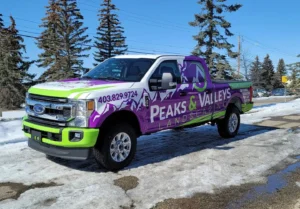
Vehicle branding versus storefront signage comes down to where customers need to notice and recognize the business. In this comparison, vehicle branding includes full wraps, partial wraps and consistent fleet graphics, while storefront signage covers exterior business identification and supporting window graphics. Mobile service businesses often benefit from vehicle branding first, while businesses that receive customers at a physical location generally need storefront signage first. Ingraph helps Calgary businesses select the investment that resolves their most important visibility problem.
How Customers Actually Discover Your Business in Calgary
The first step is identifying whether the business lacks awareness, location visibility or recognizable branding during service delivery. These are different problems and do not necessarily require the same solution.
Lead-source records show how customers initially found the business. Customer addresses, appointment patterns, walk-in counts and regular vehicle routes show where offline visibility could influence their decision. Businesses should also review how often vehicles operate in target areas and whether visitors report difficulty finding the premises.
Online lead generation does not remove the need for physical branding. If employees travel to customers after the inquiry, vehicle branding reinforces recognition during service delivery and creates exposure around job sites. If customers travel to the business, storefront signage helps them locate and confirm the premises.
When Vehicle Branding Delivers Higher ROI
Vehicle branding is more likely to outperform storefront signage when active vehicles regularly travel through areas containing the company’s target customers. Route density, operating frequency, parking visibility and geographic relevance matter more than total kilometres driven.
The business should also consider vehicle ownership and remaining service life. Wrapping a leased vehicle may require approval, while employee-owned vehicles introduce consent and brand-control concerns. A vehicle approaching replacement may not remain in service long enough to recover the investment.
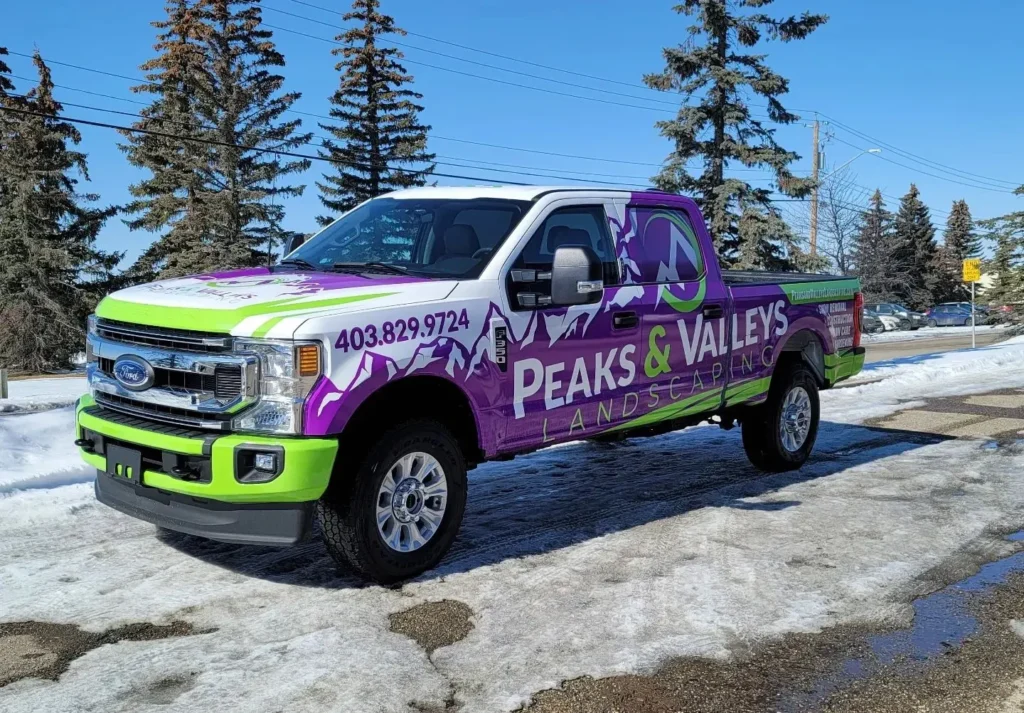
A clear commercial vehicle wrap should communicate the business name, primary service and a memorable contact method within a few seconds. Detailed service lists, small text and competing design elements reduce legibility when the vehicle is moving.
High travel frequency and service-based models
Vehicle branding suits contractors, landscapers, cleaners, delivery companies and other businesses that perform work away from their own premises. Its value increases when vehicles repeatedly travel and park within communities containing likely customers.
High traffic volume alone does not guarantee useful exposure. A vehicle operating near the intended residential, commercial or industrial market offers more relevant visibility than one travelling mainly through areas outside the service territory.
Repeated exposure also depends on recognition across separate encounters. Vehicles should use consistent colours, logos and core messaging so viewers can connect multiple sightings with the same business. Each active vehicle should receive enough relevant exposure to justify its own design, production and installation cost.
Multi-location coverage without added rent
Vehicle branding creates travelling exposure across multiple service areas without requiring a storefront in each community. It does not establish a fixed local presence, provide customer wayfinding or create a location that people can revisit.
Businesses serving a concentrated group of Calgary communities are more likely to generate repeated recognition than those making occasional trips across a broad region. Irregular coverage may produce isolated impressions without enough repetition to build familiarity.
Fleet size extends exposure only when the vehicles remain active in relevant markets. Adding graphics to vehicles that operate infrequently or outside the target territory may provide little incremental value.
When Storefront Signage Becomes the Better Investment
Storefront signage becomes the priority when customers must identify, locate or enter a physical business. Basic identification serves an operational purpose, while larger or more prominent signage may also attract attention from passing traffic.
The appropriate Calgary storefront signage depends on viewing distance, building position, surrounding signs, available mounting locations and site access. Property or landlord approval concerns what the lease and building permit. Municipal requirements concern whether the proposed sign requires authorization under applicable local rules. These requirements vary by project and should be confirmed before production.
Businesses inside multitenant buildings, industrial complexes or upper-floor units may have limited exterior placement options. Shared directories, entrance identification and approved window applications may become more important when a dedicated façade sign is unavailable.
Walk-in dependency and location-based demand
Retail stores, restaurants, salons and showrooms generally need visible storefront identification before opening because spontaneous visits and local traffic contribute directly to customer acquisition. Clinics, professional offices and appointment-only businesses may not depend on walk-ins, but visitors still need to confirm that they have reached the correct entrance.
The sign must remain readable from the customer’s likely approach. Building setbacks, parked vehicles, landscaping, neighbouring signs and traffic speed affect the required size and placement. Visibility from immediately outside the entrance is insufficient when customers first encounter the property from a road or parking-lot access point.
Nighttime legibility matters when customers arrive after dark or when evening traffic contributes to demand. Illumination should be evaluated against operating hours, surrounding light, electrical requirements and any restrictions on illuminated signage.
Reinforcing credibility at a fixed address
Storefront signage connects the business name customers encountered online, through referrals or in advertising with the physical premises they reach. This consistency reduces uncertainty and helps visitors distinguish the business from neighbouring tenants.
A sign does not prove that a business is stable or reputable. It supports confidence by providing recognizable identification, a clear entrance and visual consistency with the company’s other branding.
Businesses that receive most leads online may still need storefront identification to support appointments, pickups and in-person purchases. However, a physical address that customers never visit does not automatically justify making storefront signage the primary advertising investment.
Cost vs Exposure: What You’re Really Paying For
Vehicle branding and storefront signage should be compared using all-in cost, expected service period and attributable business results. A quoted production price alone does not account for preparation, installation, approvals, maintenance or the time the asset will remain useful.
| Decision factor | Vehicle branding | Storefront signage |
| Primary exposure | People near travel routes, parking areas and job sites | People approaching, passing or visiting one fixed location |
| Cost structure | Scales by number of vehicles, vehicle size and graphic coverage | Depends on fabrication, mounting, access, illumination and site requirements |
| Exposure control | Changes with routes, parking and vehicle availability | Remains tied to the building and surrounding traffic |
| Operational interruption | Vehicle may be unavailable during preparation and installation | Installation requires property access and coordination |
| Relevant service period | Shorter of the wrap’s expected life or remaining vehicle ownership period | Shorter of the sign’s expected life or remaining occupancy period |
| Response measurements | Tracked inquiries, branded URL visits and lead-source records | Walk-ins, location searches, directional inquiries and completed visits |
| Primary limitation | Exposure falls when the vehicle is inactive or outside the target market | Visibility remains limited to one location |
Annualized cost provides a more useful comparison than upfront price. Divide the total installed cost by the realistic number of years the business expects to use the vehicle or occupy the premises. This prevents a long-lasting asset from appearing less efficient solely because it has a higher initial price.
Cost per qualified inquiry divides the investment by attributable qualified leads. Customer acquisition cost divides it by customers acquired. Neither calculation is ROI. ROI compares the financial return generated by the asset with the amount invested, preferably using attributable gross profit rather than revenue alone.
Exposure estimates indicate how often branding might be seen, but they do not establish commercial performance. Qualified leads, acquired customers and gross profit show whether visibility translated into business. Both options should be assessed over comparable operating periods long enough to account for normal seasonal changes.
Attribution remains imperfect because customers may encounter physical branding before searching online or requesting a referral. Consistent lead-source questions, dedicated landing pages and location-specific tracking provide stronger evidence than estimated impressions alone.
Combining Both: When a Hybrid Approach Outperforms
A hybrid approach makes sense after the first asset adequately handles its primary task. Vehicle branding should already create clear mobile recognition, or storefront signage should already make the location easy to identify. The second investment should then solve a separate, documented visibility problem.
Launching both simultaneously is reasonable when customers will encounter both from the beginning. A service company with branded vehicles and a customer-facing showroom, for example, needs mobile awareness and fixed-location identification to support different stages of the same journey.
The formats should share recognizable visual elements without using identical layouts. Vehicle graphics require short information readable at a distance. Storefronts provide stable identification and allow supporting information to be presented at pedestrian viewing distance.
Businesses with substantial glass frontage may add custom window graphics for services, hours or privacy requirements. These graphics should support the main storefront identity without hiding the entrance or making the premises harder to recognize. The second format should produce enough incremental customer value to justify its cost. If the existing asset already reaches the intended market and no separate visibility gap exists, duplicating exposure may deliver a weaker return than improving the original installation.
Choosing Based on Your Business Stage, Not Preference
An early-stage mobile service business with an active vehicle and no customer-facing premises will usually benefit from vehicle branding first. A new retailer, restaurant, clinic or showroom should prioritize storefront identification before opening because customers must locate and recognize the premises.
Owning or leasing commercial space does not automatically make storefront signage the better acquisition investment. If customers never visit the address, the location may require only the identification necessary for operations, while vehicle branding receives the larger marketing allocation.
Established businesses should evaluate what their existing asset already accomplishes. A company with effective storefront visibility may add vehicle branding when it expands delivery, installation or field services. A mobile business with recognizable vehicles may prioritize storefront signage when it opens a showroom, pickup counter or appointment location.
The expected service period should also support the investment. A wrap should not be evaluated beyond the planned ownership of the vehicle, and a storefront sign should not be evaluated beyond the realistic occupancy of the premises. Short remaining terms reduce the time available to recover design, production and installation costs.
The correct first investment is the format that removes the clearest obstacle to customer awareness, service recognition or arrival. Ingraph provides vehicle wraps, exterior signs and window graphics for Calgary businesses with mobile, fixed-location and hybrid visibility requirements.