Choosing the right storefront sign for your location in Calgary involves more than selecting a sign style. The effectiveness of a sign depends on how people approach the business, how much time they have to see it, what obstacles affect visibility, and how much competition surrounds the storefront. A sign that performs well in one location may be difficult to see in another. Ingraph helps Calgary businesses select signage based on real visibility conditions rather than appearance alone.
What Your Storefront Location Demands From a Sign
Every storefront creates different visibility challenges. The amount of traffic, viewing angles, building position, and surrounding businesses all affect how easily customers can find the location. The best sign is not necessarily the largest sign. It is the sign that remains visible to the people most likely to become customers.
Storefront position also matters. Corner units, recessed entrances, second-floor businesses, and locations set back from the road often require different visibility strategies because customers approach and view them differently. Businesses that receive both pedestrian and vehicle traffic typically need signage that remains effective at multiple distances and viewing speeds.
Street Exposure vs Foot Traffic Patterns
The type of traffic passing the storefront should influence sign selection. Locations that depend primarily on vehicle traffic often require signs that can be recognized quickly from greater distances. Drivers have limited time to process information, so visibility, readability, and concise messaging become the primary priorities.
Locations with significant pedestrian traffic can support more detailed messaging because people move more slowly and often view the storefront from closer distances. Business names, service descriptions, hours, and directional information are often easier to absorb in walkable commercial environments.
Retail shops, restaurants, salons, and service businesses in pedestrian-oriented areas frequently benefit from signage designed for close-range viewing.
Viewing Distance, Speed, and Line of Sight
Viewing distance directly affects how much information people can absorb. A storefront viewed from across a wide road requires larger lettering, simpler messaging, and stronger contrast than a storefront viewed from a sidewalk. Vehicle speed creates a similar constraint because faster-moving traffic reduces viewing time.
Line of sight is equally important. Buildings, landscaping, utility poles, parked vehicles, neighbouring signs, and architectural features can block visibility from key approaches. A sign should be positioned where customers naturally see it rather than where mounting is most convenient.
If visibility conditions vary depending on the approach direction, businesses should prioritize the routes most customers use when arriving at the location.
Competing Visual Noise in the Area
Visual noise refers to the number of competing elements fighting for attention within the same viewing area. Shopping centres, commercial corridors, and busy urban streets often contain numerous signs, displays, advertisements, architectural features, and storefronts. In these environments, visibility depends on creating clear recognition rather than simply adding more information.
A larger sign does not automatically solve visibility challenges. Strong contrast, clear branding, and easy recognition often contribute more to visibility than overall sign size when multiple businesses compete for attention.
Matching Sign Type to Storefront Conditions
Different sign types solve different visibility problems. The storefront layout often determines which option provides the strongest visibility. Choosing the correct sign type allows the business to work with the location rather than against it. However, businesses should also consider landlord requirements, shopping centre sign criteria, and municipal sign regulations that may affect available options.
Flush-Mounted Signs for Close-Range Visibility
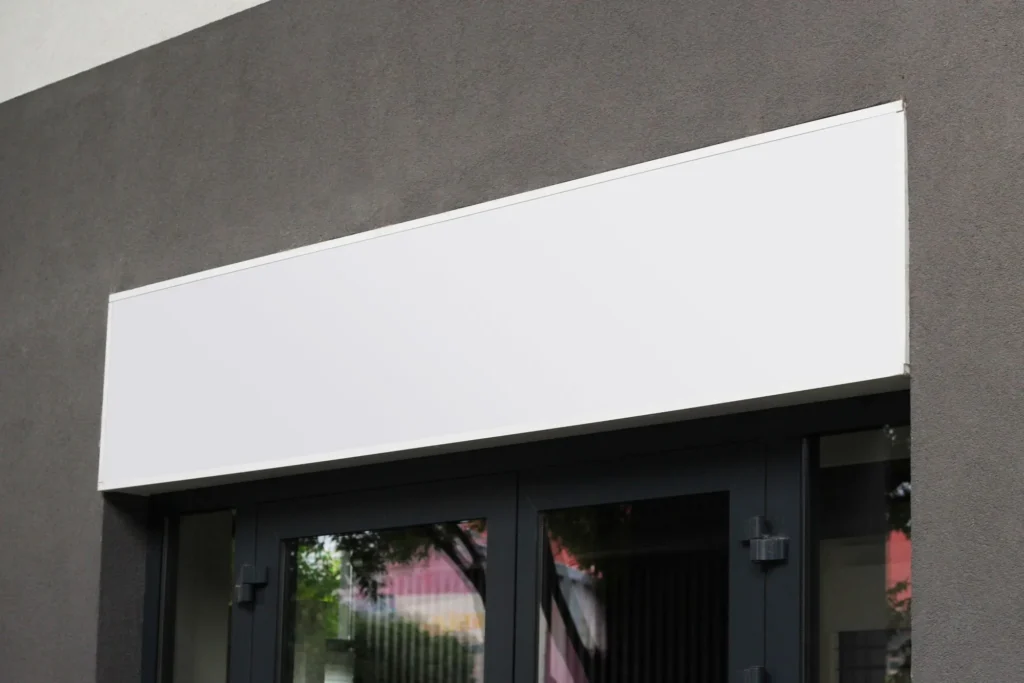
Flush-mounted signs attach directly to the building facade and face outward toward approaching traffic.
They work best when customers approach the storefront directly and have a clear view of the building face. This is common in strip malls, retail plazas, and standalone commercial buildings where customers view the storefront from parking lots or access roads.
Their effectiveness decreases when customers primarily approach from the side or when the storefront sits significantly back from the primary viewing area because visibility becomes more dependent on distance and viewing angle.
Projecting Signs for Sidewalk Traffic Flow
Projecting signs extend outward from the building and remain visible to people travelling parallel to the storefront.
They are often effective in walkable commercial districts where pedestrians move along the sidewalk rather than directly toward the business. Because the sign projects into the viewing path, customers can identify the business before they reach the storefront itself.
Projecting signs can also help businesses located within continuous rows of storefronts where flush-mounted signs compete for attention along the same facade. Their value is typically greatest in pedestrian-oriented environments rather than locations dominated by vehicle traffic.
Window Graphics for Limited Exterior Space
Window graphics can provide visibility when exterior mounting space is limited or restricted. They are commonly used on storefronts with large glass surfaces, narrow facades, recessed entrances, or architectural constraints that limit traditional sign placement. Window graphics can communicate branding, services, hours, and directional information without requiring additional building-mounted structures.
Their effectiveness may be reduced when storefront windows experience heavy reflections, significant tinting, or long viewing distances that make detailed graphics difficult to read.
In some situations, window graphics complement mounted signs rather than replace them. This is particularly true when the primary sign identifies the business from a distance while the window graphics provide supporting information closer to the storefront.
Placement Mistakes That Reduce Visibility
Even well-designed signs can underperform when placement decisions create visibility problems. Many visibility issues result from installation decisions rather than design quality.
Obstructed Sightlines and Poor Mounting Height
A sign must remain visible from the locations where customers first begin searching for the business.
Trees, landscaping features, neighbouring buildings, parked vehicles, utility infrastructure, and architectural elements can block important sightlines. Some obstructions may also change throughout the year as vegetation grows or seasonal displays are installed.
Mounting height affects visibility as well. Signs installed too low can become blocked by vehicles or pedestrians. Signs installed too high may fall outside the natural viewing path of approaching customers. The appropriate height depends on the primary audience, viewing distance, and approach direction.
Overcrowded Design in High-Competition Areas
High-competition areas contain numerous neighbouring signs competing for the same attention. These environments often encourage businesses to add more information to their signage. This approach frequently reduces visibility rather than improving it.
Most viewers identify the business first and only process secondary information afterward. Excessive text, multiple messages, crowded layouts, and competing visual elements can make recognition more difficult. In busy commercial environments, clarity often creates stronger visibility than information density.
When to Combine Multiple Sign Types for Better Coverage
A business may need visibility from multiple directions, multiple distances, or multiple traffic types. In these situations, combining sign types can improve overall coverage. For example, a flush-mounted sign may identify the storefront from a parking lot while a projecting sign improves visibility for sidewalk traffic. Window graphics can then provide supporting information for customers who move closer to the storefront.
This approach is particularly useful for corner units, recessed storefronts, businesses located within large retail centres, and locations where customers approach from different directions.
However, not every storefront requires multiple sign types. Businesses should first evaluate visibility from their primary customer approach routes to determine whether meaningful visibility gaps exist before expanding their signage strategy.
The goal is not to add more signage. The goal is to ensure customers can identify the business consistently from the locations where visibility matters most.
Get a Storefront Sign Strategy Designed for Your Business
The most effective storefront sign depends on how customers approach the location, what visibility challenges exist, and which sign type addresses those conditions most effectively.
Traffic type, viewing distance, sightlines, storefront constraints, and competing visual elements all influence sign performance. Businesses that focus only on sign size or appearance often overlook the factors that determine whether the sign will actually be seen.
Ingraph helps Calgary businesses evaluate storefront conditions and develop signage strategies that align with how customers see, approach, and identify the business in the real world.