Partial vs full vehicle wraps is a decision that directly affects how visible your brand is, how consistent it appears, and how efficiently your marketing budget is used across vehicles. The right choice depends on how often the vehicle is seen, how much surface area is available, and how important brand dominance is in your service area. Ingraph works with both partial and full wrap strategies, so this comparison focuses on when each option performs effectively for business use.
Understanding Coverage Options: Partial vs Full Wrap
Coverage determines how much of the vehicle is used for branding and how the design integrates with the original paint.
What Defines a Partial Wrap
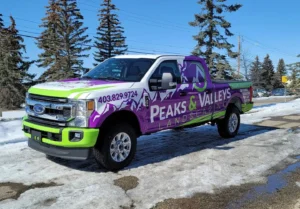
A partial wrap typically covers 25 percent to 75 percent of the vehicle surface. This usually includes high-visibility panels such as doors, rear quarter panels, tailgates, and portions of the hood, while leaving other areas in the original paint.
Partial wraps rely on either contrast or colour matching. Some designs intentionally contrast with the base paint to stand out, while others attempt to match the original colour to create a more seamless look. The choice affects visibility and cost, and mismatches can reduce visual clarity.
What Defines a Full Wrap
A full wrap covers approximately 90 percent to 100 percent of painted exterior surfaces, including doors, fenders, hood, roof, and rear sections. Trim areas, deep recesses, or non-painted components may not always be wrapped depending on scope.
Full wraps remove dependence on the original paint colour, allowing full control over layout, contrast, and readability. This makes them more predictable in outcome across different vehicle types and conditions.
Visibility and Brand Impact by Coverage Type
The effectiveness of a wrap depends on how quickly a viewer can recognize the brand and understand the message in real-world conditions.
When Partial Wraps Are Sufficient
Partial wraps are effective when vehicles operate in lower-speed environments such as residential areas, local service routes, or repeated neighbourhood exposure where viewing time is longer.
They also perform well when the brand already has recognition or when the goal is reinforcement rather than initial awareness. In these cases, readability is less dependent on full surface coverage and more on placement and contrast.
When Full Wraps Become Necessary
Full wraps become necessary in higher-speed or high-density environments such as arterial roads, highways, and busy commercial zones where viewers have only a few seconds to process information.
They are also more effective in competitive markets where multiple branded vehicles are present. A full wrap ensures consistent visibility from multiple angles, which increases the likelihood of recognition during short exposure windows.
Full wraps do not automatically outperform partial wraps in lead generation. Performance depends on driving frequency, route exposure, and design quality. However, they create more consistent visibility under varying conditions.
Cost Efficiency vs Exposure: Finding the Right Balance
The decision between partial and full wrap comes down to how much exposure is gained per dollar spent and how that aligns with business goals.
| Coverage Type | Coverage % | Typical Cost Range | Visual Impact | Scalability |
|---|---|---|---|---|
| Partial Wrap | 25 to 75 percent | $1,500 to $3,500+ depending on vehicle size and design complexity | Moderate to high with proper contrast and placement | Easier to scale across fleets |
| Full Wrap | 90 to 100 percent | $3,000 to $6,000+ depending on size and coverage detail | High and consistent across all viewing angles | Higher cost per unit |
Cost varies based on vehicle size, surface complexity, and design requirements. Larger vehicles with flat panels typically cost more in material but allow better design efficiency, while complex curves increase labour time.
A partial wrap becomes more cost-efficient when the goal is to brand more vehicles within a fixed budget. A full wrap becomes more cost-efficient when fewer vehicles must generate higher visibility individually.
A practical threshold is fleet size versus exposure need. If budget allows branding five vehicles partially or two vehicles fully, the decision depends on whether coverage area or per-vehicle impact drives results.
Vehicle Type and Layout Considerations
Vehicle shape and panel layout directly affect how readable and effective a wrap will be.
Vans, Trucks, and Service Vehicles
Larger vehicles provide flat panels and extended side sections, which improve readability by allowing larger text, cleaner layouts, and better spacing. This makes partial wraps more viable because key information can still be displayed clearly.
However, full wraps on these vehicles create a stronger visual presence and eliminate dependency on base colour, which becomes important in competitive service environments.
Irregular surfaces such as deep contours, door seams, and hardware interruptions can reduce usable design space and affect both wrap types, requiring adjustments in layout.
Compact Cars and Limited Surface Area
Compact vehicles have limited panel size, which restricts how much information can be displayed clearly. This increases the risk of clutter and reduced readability, especially with partial wraps.
Full wraps tend to perform better on smaller vehicles because they maximize available surface area and create a unified visual. Partial wraps require more precise design to maintain clarity and avoid fragmentation.
Scaling Branding Across Multiple Vehicles
Fleet decisions require balancing consistency, cost, and overall brand exposure.
Consistency Across a Fleet
Full wraps provide consistent appearance regardless of vehicle colour or condition, which strengthens recognition across multiple impressions. Consistency improves recall when customers encounter the brand repeatedly in different locations.
Partial wraps can maintain consistency only if vehicle colours are standardized or designs are adapted to each unit. Without that control, variation in appearance can reduce recognition over time.
Budget Allocation Across Multiple Units
Partial wraps allow more vehicles to be branded within a fixed budget, increasing geographic reach. For example, a budget that covers two full wraps may cover four or more partial wraps depending on vehicle type.
Full wraps reduce the number of vehicles that can be branded but increase the visibility of each unit. This approach is more effective when each vehicle must perform as a primary lead source.
A hybrid strategy can be used, where high-visibility vehicles receive full wraps and lower-exposure units use partial wraps. This approach balances cost and impact when fleet roles vary.
Situations Where Partial Wraps Underperform
Partial wraps lose effectiveness when base vehicle colour reduces contrast, when designs do not align with body lines, or when key branding elements are not visible from primary viewing angles.
They also underperform in high-speed environments such as highways or major roads, where limited viewing time reduces message retention. In these conditions, full wraps provide more consistent visibility.
Design improvements can increase partial wrap effectiveness, but they cannot fully compensate for limited coverage. When surface area is insufficient, readability and impact will still be constrained.
Partial wraps may still be used in constrained scenarios such as short-term campaigns, strict budget limits, or vehicles with limited exposure requirements.
Choosing the Right Wrap Strategy for Your Business
The choice between partial and full wraps depends on how the vehicle is used, how competitive the environment is, and how important each vehicle is as a marketing asset.
A partial wrap is typically appropriate when budget per vehicle is limited, when vehicles operate in predictable low-speed areas, and when branding is used for reinforcement rather than primary visibility.
A full wrap is more appropriate when vehicles operate in high-traffic environments, when immediate recognition is required, and when each vehicle must generate strong individual visibility.
A practical decision framework is based on three factors. Budget per vehicle, required visibility level, and number of vehicles in operation. When visibility per vehicle is critical and fleet size is small, full wraps are more effective. When coverage across a wider area is the priority, partial wraps allow broader deployment.