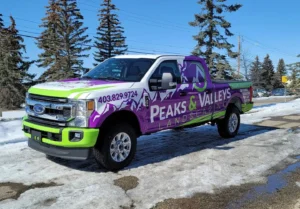
The best vehicles for wrap advertising combine usable branding space, clear sightlines, and frequent exposure in the areas a business serves. A large vehicle can display more information, but size alone does not guarantee effective advertising. The vehicle’s body shape, daily routes, and parking locations all affect how easily people recognize the brand and understand the message. Ingraph helps Calgary businesses evaluate these factors when selecting vehicles for individual or fleet wrap advertising.
What Makes a Vehicle Effective for Advertising
An effective advertising vehicle provides enough uninterrupted space to communicate a recognizable brand and a limited amount of essential information. It also positions that information where drivers, pedestrians, and nearby property owners can easily see it during everyday use.
Surface Area and Panel Continuity
Large, flat body panels provide the greatest flexibility for vehicle advertising. Cargo vans, box trucks, and enclosed trailers accommodate larger logos, stronger visual elements, and more readable contact information than compact passenger vehicles.
Panel continuity is just as important as total surface area. Door handles, wheel arches, windows, trim, sliding door tracks, and deep body lines interrupt the available design space and can divide important graphics into separate sections. A vehicle may appear large overall while offering surprisingly little uninterrupted space for branding.
For this reason, logos, website addresses, and phone numbers generally perform best when placed on a single continuous panel instead of extending across multiple doors or interrupted body sections. Large side panels, rear doors, and flat door surfaces usually provide the clearest locations for branding because they remain visible from common viewing angles.
Readability While in Motion vs Parked
Advertising seen while a vehicle is moving must communicate almost instantly. Other drivers may only view the vehicle for a few seconds, making a recognizable logo, clear service description, and simple visual identity more valuable than large amounts of text.
Parked vehicles create different opportunities. A service van outside a customer’s property or a delivery vehicle at a commercial location may remain visible for an extended period, allowing viewers to absorb additional information without feeling overwhelmed. Businesses should decide which viewing condition occurs most often during normal operations and prioritize the design accordingly.
Vehicles travelling primarily on highways generally benefit from larger graphics and less text because viewing time is shorter. Vehicles that spend much of the day parked in residential neighbourhoods or commercial areas can support slightly more information while still keeping the primary branding immediately recognizable.
Driving Patterns and Exposure Frequency
The value of a wrapped vehicle depends on how often it is seen by potential customers rather than simply how many kilometres it travels. A compact vehicle driving through busy Calgary neighbourhoods every day may generate more useful exposure than a larger truck that spends most of its time on private industrial sites.
Repeated travel through populated service areas, extended parking at visible job sites, and regular stops near businesses or residential properties all increase advertising opportunities. Businesses should evaluate where their customers are located and whether the vehicle operates within those areas consistently. Matching vehicle use to the target service area often has a greater influence on advertising effectiveness than vehicle size alone.
Vehicle Types Ranked by Advertising Effectiveness
The most effective vehicle depends on the amount of branding space required, the company’s daily operations, and where the vehicle is normally driven or parked.
| Vehicle Type | Visibility | Branding Space | Use Case |
|---|---|---|---|
| Box truck | Very High | Extensive | Moving companies, restoration, equipment suppliers |
| Cargo van | High | Large | Trades, contractors, cleaning, HVAC, plumbing |
| Enclosed trailer | High | Extensive | Landscaping, renovation, equipment transport |
| Step van | Very High | Extensive | Delivery services, mobile retail |
| Pickup with canopy | Moderate to High | Large | Contractors, landscaping, field services |
| Standard pickup | Moderate | Moderate | Construction, maintenance, agriculture |
| Large SUV | Moderate | Moderate | Sales teams, service professionals |
| Minivan | Moderate | Moderate | Cleaning, healthcare, childcare |
| Sedan | Moderate to Low | Limited | Sales representatives, consultants |
| Compact hatchback | Low to Moderate | Limited | Local delivery, personal branding |
Box trucks and step vans provide the greatest advertising space because their large side panels resemble mobile billboards. They work best when business operations already require vehicles of that size. Purchasing an oversized vehicle solely to increase wrap area may reduce overall return if operating costs exceed the additional advertising value.
Cargo vans often provide the best balance between practicality and advertising performance for service businesses. Their large side panels, rear doors, and manageable size make them suitable for residential routes while providing significantly more branding space than most passenger vehicles.
Pickup trucks, SUVs, minivans, and passenger cars can still perform effectively when the wrap design is adapted to the available space. Simpler branding generally produces stronger results on these vehicles because smaller panels limit how much information can be displayed clearly.
Vehicles That Underperform for Wrap Advertising
Vehicles generally underperform when their body design limits usable advertising space or when their normal operating conditions prevent the wrap from being seen consistently. This does not mean they cannot be wrapped, only that the design must work within greater physical limitations.
Limited Panel Space and Broken Surfaces
Sports cars, compact coupes, heavily sculpted body styles, and vehicles with extensive trim often provide limited uninterrupted surfaces for commercial graphics. Curved panels, spoilers, vents, wheel arches, roof racks, sliding doors, toolboxes, ladder racks, and other exterior equipment can interrupt important design elements and reduce readability.
Vehicle condition also influences wrap performance. Existing paint damage, corrosion, or body repairs may limit suitable installation areas or affect the appearance of finished graphics.
When uninterrupted space is limited, concentrating branding on the strongest available panels often produces better results than attempting to cover the entire vehicle. In these situations, a partial wrap may communicate the business more clearly than a full wrap because the design remains readable instead of being divided across numerous body features.
Poor Visibility Angles in Traffic
Some vehicles provide adequate wrap coverage but remain difficult to see under normal traffic conditions. Low profile passenger cars are frequently hidden behind SUVs, vans, and pickup trucks, reducing the time other drivers spend viewing the graphics. Likewise, branding placed primarily on the hood or roof contributes little during ordinary road use because those surfaces are rarely visible from typical viewing positions.
Rear visibility also affects advertising performance. Vehicles operating in urban traffic often spend considerable time viewed from behind, making the rear panel an important branding location. Businesses should also consider how ladders, cargo, trailers, lift gates, or open tailgates may regularly block graphics during normal operations. Designing around actual vehicle use generally produces better long term advertising results than designing around an empty vehicle.
Matching Vehicle Type to Business Type
Selecting the right vehicle begins with business operations. Advertising performance should complement operational requirements rather than determine which vehicle is purchased.
Service-Based Businesses (Local Routes)
Cargo vans and pickup trucks generally provide the strongest balance between functionality and advertising exposure for service businesses. Trades such as plumbing, electrical, HVAC, restoration, landscaping, and cleaning frequently operate throughout residential neighbourhoods where vehicles remain visible while travelling between appointments and parked outside customer properties.
Cargo vans typically provide more continuous branding space, while pickup trucks remain practical when towing equipment or transporting larger materials. Adding a canopy can increase usable advertising space, provided the overall design remains visually consistent across the entire vehicle.
Delivery and Fleet Operations
Delivery companies, logistics providers, restoration businesses, and organizations operating multiple vehicles often benefit from box trucks, cargo vans, step vans, or enclosed trailers because these vehicles provide large, consistent advertising surfaces.
Fleet branding should maintain consistent colours, logos, typography, and information hierarchy regardless of vehicle model. Individual layouts may change to suit different body styles, but customers should immediately recognize every vehicle as belonging to the same company. Ingraph provides fleet vehicle graphics that can be adapted across different vehicle types while maintaining a unified brand identity.
Personal Vehicles Used for Branding
Sedans, hatchbacks, SUVs, and personal pickup trucks can still serve as effective advertising platforms when a dedicated commercial vehicle is unnecessary. These vehicles usually benefit from a simpler design focused on a recognizable logo, service category, and straightforward contact information.
A full wrap is not automatically the best solution for every personal vehicle. On smaller body styles, a partial wrap may create stronger branding because it emphasizes the most visible panels without overwhelming limited design space. Businesses should also consider how frequently the vehicle is driven and where it is typically parked, since exposure opportunities ultimately determine advertising value.
Build a Vehicle Wrap Strategy That Maximizes Exposure
An effective vehicle wrap strategy balances branding space, operating requirements, daily routes, and parking visibility. While cargo vans and box trucks generally provide the strongest advertising surfaces, they are not automatically the best investment for every business. A smaller vehicle operating consistently within the company’s target market may generate greater brand recognition than a larger vehicle that spends little time in public view.
Businesses should evaluate how often each vehicle is driven, where it normally travels, which sides receive the greatest visibility, and whether the available body panels can communicate the brand clearly. They should also determine whether a full wrap, partial wrap, or decal package best suits the available surfaces while considering how future vehicles can maintain a consistent appearance as the fleet grows.
The vehicle should always satisfy operational requirements first. Once the appropriate vehicle has been selected, the wrap design can maximize its strongest viewing areas to create clear, repeatable brand exposure. Ingraph designs and installs full wraps, partial wraps, vehicle decals, and fleet graphics that are tailored to the way Calgary businesses actually use their vehicles.